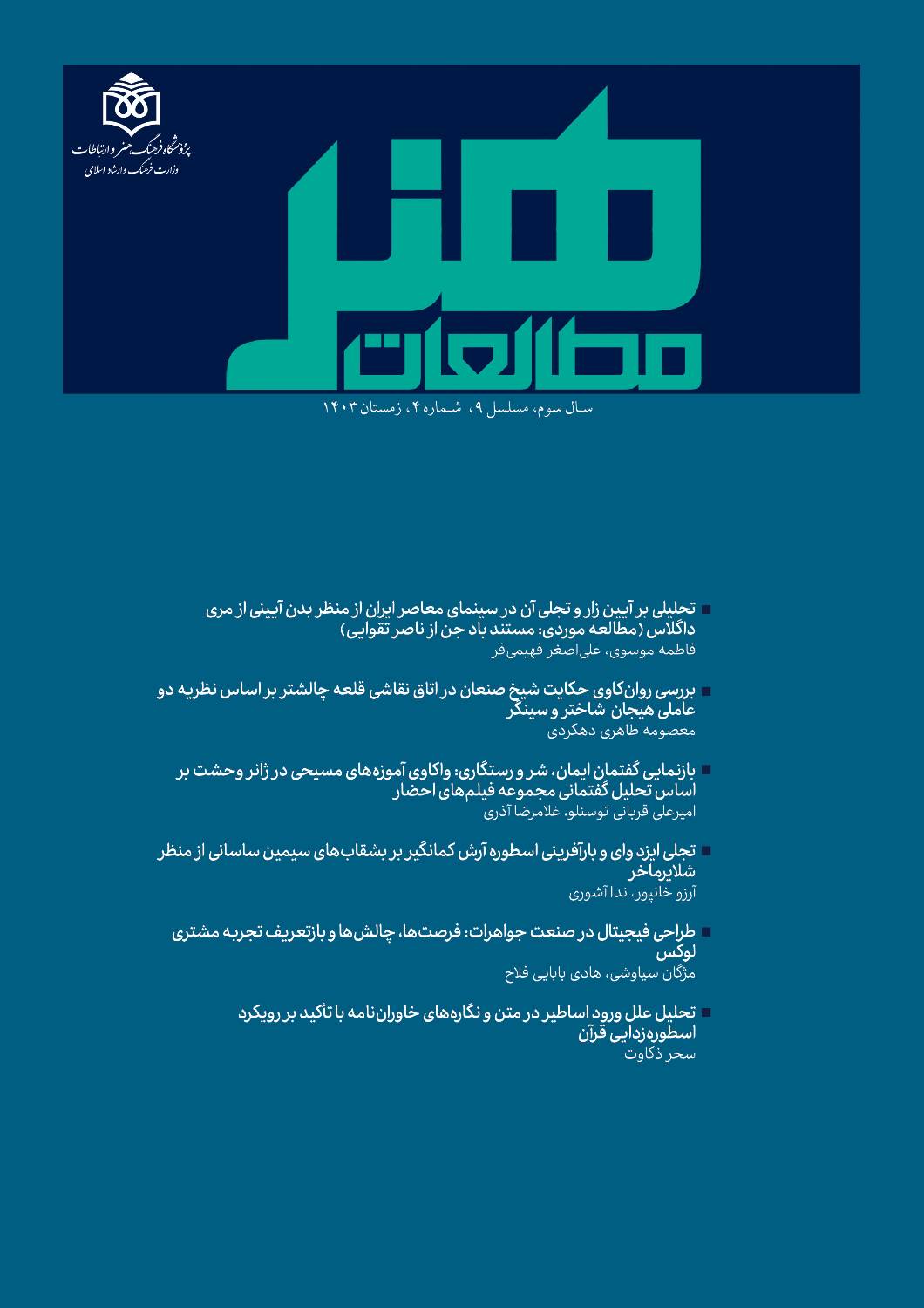
نوع مقاله : مقاله پژوهشی
موضوعات
عنوان مقاله English
نویسندگان English
The horror genre has long served as a fertile ground for exploring questions of metaphysics, morality, and the unseen forces that shape human experience. Within this domain, The Conjuring Universe stands out as one of the most influential contemporary franchises that not only revitalizes supernatural horror but also embeds within its narratives a complex set of Christian theological motifs. This research, drawing upon the frameworks of discourse analysis and cultural semiotics, investigates how Christian teachings—particularly those concerning evil, salvation, faith, and spiritual authority—are represented, circulated, and normalized within the Conjuring film series. By employing the theoretical perspectives of Michel Foucault on power/knowledge, Norman Fairclough’s critical discourse analysis, and film semiotics, the study examines how religious discourse operates within modern horror cinema and how it shapes viewers’ perceptions of the relationship between fear and faith in a postmodern cultural context.
The central aim of the study is to answer the following question: What discourses regarding the interaction between faith and fear are constructed through the portrayal of Christian rituals, demonology, and spiritual warfare in the Conjuring Universe? To address this, the research analyzes the narrative structures, character archetypes, visual symbolism, and auditory design of the films, situating them within broader cultural narratives about religion, secularism, and the crisis of spiritual meaning in contemporary society. Through this approach, the study reveals that the Conjuring Universe does not merely deploy Christian imagery as a storytelling device; rather, it constructs a coherent religious discourse that functions to reaffirm the authority of faith in the face of modern skepticism.
The findings indicate that the films consistently rely on the dualistic opposition of good versus evil, wherein Satanic forces are depicted as real, immediate, and omnipresent threats to the human world. This dichotomy serves as a cornerstone of the films’ Christian discourse, positioning faith, divine protection, and religious knowledge as the primary means of overcoming supernatural evil. Through Foucault’s lens, the films can be interpreted as reasserting the authority of religious institutions by framing spiritual knowledge as a specialized power accessible only to certain figures—such as exorcists, priests, or spiritually gifted individuals. In this way, The Conjuring series reinstates a hierarchical structure of religious authority within a secular age.
Another significant discourse illuminated by the study concerns the portrayal of the female body. Across multiple films in the franchise, women and girls become central sites of possession, spiritual vulnerability, and demonic intervention. This recurring narrative structure, when analyzed semiotically, positions the female body as a symbolic battlefield where the forces of good and evil contest power. The films thereby reproduce long-standing Christian-cultural associations between femininity, purity, temptation, and spiritual danger. Moreover, through Fairclough’s critical discourse lens, such representations contribute to the normalization of gendered spiritual narratives, subtly reinforcing traditional Christian views on morality, domesticity, and spiritual susceptibility.
The research also emphasizes the role of cinematic techniques—such as chiaroscuro lighting, the interplay of silence and sudden sonic ruptures, religious iconography, and spatial symbolism—in binding the emotional experience of fear to the affirmation of faith. Horror, in this context, becomes not only a source of terror but also a pathway to spiritual reflection. The films craft an aesthetic where divine presence is often revealed at the threshold of maximum fear, implying that proximity to terror can become a catalyst for rediscovering the sacred. This aesthetic structure supports the broader argument that the Conjuring Universe functions as a cultural medium through which the sacred is reintroduced in a postmodern world characterized by fragmentation, relativism, and declining institutional religiosity.
Ultimately, the study concludes that the Conjuring Universe does more than entertain; it participates in a contemporary rearticulation of Christian discourse. By dramatizing spiritual warfare and positioning religious rituals—especially exorcism—as effective, necessary, and authoritative, the films symbolically counteract secular explanations of evil, trauma, and psychological distress. This symbolic work enables the films to reassert Christianity’s relevance in addressing existential anxieties that persist in modern life. Therefore, the Conjuring series can be understood as a cinematic space where the sacred re-emerges, not despite the horror, but through it. The genre becomes a liminal arena in which viewers confront questions of belief, morality, and metaphysical order, suggesting that horror cinema may serve as one of the few remaining cultural platforms in which religious discourse retains both narrative power and emotional resonance.
کلیدواژهها English